

Claude at Bennington, 1982
Teaching, Love, and a Life in Transition

I remember Claude’s office in the Commons building at Bennington—northeast corner, second floor. Two six-over-six windows framed the space, their deep sills holding a black rotary phone in one and, in the other, a small portable French gas stove where Claude would warm the simple meals he brought from home. At the center of the room sat a shiny round black table, where a delicate arrangement of fresh-cut flowers, pressed into a steel frog, rested in a beautiful bowl—Claude almost always kept fresh flowers there, thoughtfully arranged. Against one of the plain white walls stood a bookcase, filled with Greek and Latin texts and dictionaries, and in one corner, atop the case, a modest collection of liquors and glasses, waiting for evening company.
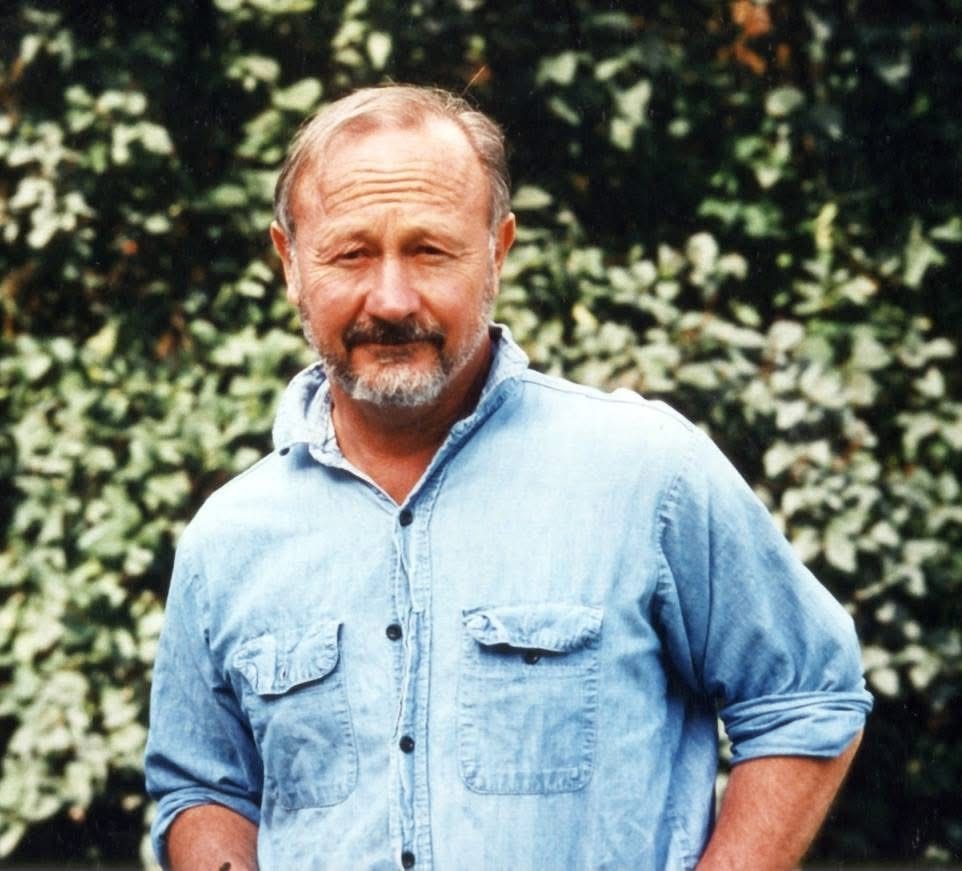
Claude as a Teacher
This was where I first knew him. I took three courses with Claude—The Iliad (1989), Virgil & Dante (1990), and Religious Experience (1991). His classes met not in the main classroom building—The Barn—but in the living rooms of the old white clapboard student houses beyond Commons, usually Franklin House in those years. In early spring and late fall, the fireplace burned warmly as he lectured directly from the text, guiding discussion and soliciting questions from the class. Students would sit in one of two couches flanking the fireplace or in other chairs scattered about the room, while Claude sat in an upright chair, one leg crossed over the other, the book resting against his knee—the folded knee becoming, in a way, his lectern. He was accustomed to holding this posture for long periods, having maintained a daily meditation practice ever since his time in Japan, where he became a Buddhist in 1966.
When I read these pages from Claude’s 1982 journal, I can picture him in that office, in those houses, in those years. He was 58, still at the height of his powers as a teacher, yet living through a time of personal and institutional change.
Teaching, Love, and Bennington in Transition
In this set of journal entries—written over three consecutive dates in June 1982—Claude records the final days of the school year. He writes of teaching The Divine Comedy, of reading the final cantos of Paradiso aloud to his students on their last day. He notes the bittersweet conclusion of the course, the shared meal that followed—one of his great traditions, where he would cook an elaborate, thematically inspired feast for the entire class.
A Life in Flux
At the same time, his personal life was shifting. That spring, Claude lived in his office Monday through Friday, sleeping on a futon on the floor and cooking simple meals on his small stove. He wanted to be close to Edward, a student at the college with whom he had fallen deeply in love, even as his long-term relationship with David, who waited at home in Pawlet, was unraveling.
A Changing Bennington
Beyond Claude’s personal life, Bennington itself was changing. Once a small, radical, faculty-led institution, Bennington was shifting—becoming more administrative, its structure growing more top-heavy. Claude, who had been teaching there for over 20 years, valued the intellectual freedom and intimacy of the old Bennington and viewed these shifts with deep concern. He saw the College moving in a direction that felt less like the place he had devoted much of his life to.
These entries mention several of his Literature Division faculty colleagues, including Arturo Vivante, Stephen Sandy, and Nicholas Delbanco, as well as other faculty colleagues such as Arnold Ricks and Leroy Logan. Close friends like Bernard Malamud, Luis de Monguió and his wife Alicia de Colombí-Monguió, and Peter Golub are also mentioned. But even with familiar faces around him, the atmosphere of the College was shifting, and the tensions between tradition and change were becoming more pronounced—trends that would only intensify in the years to come.
Yet, for Claude, the essence of his life remained unchanged. His world was built on literature, on human connection, on the belief that teaching was an art as profound as writing itself. No matter what changed around him, his purpose—his devotion to words, to his students, to the act of transmitting knowledge—held steady.
Claude’s Final Class of 1982
Claude’s journal from these days captures these tensions vividly. In the excerpt below, he describes the final moments of his Divine Comedy course—the closing of another year, another class, and a life in transition.
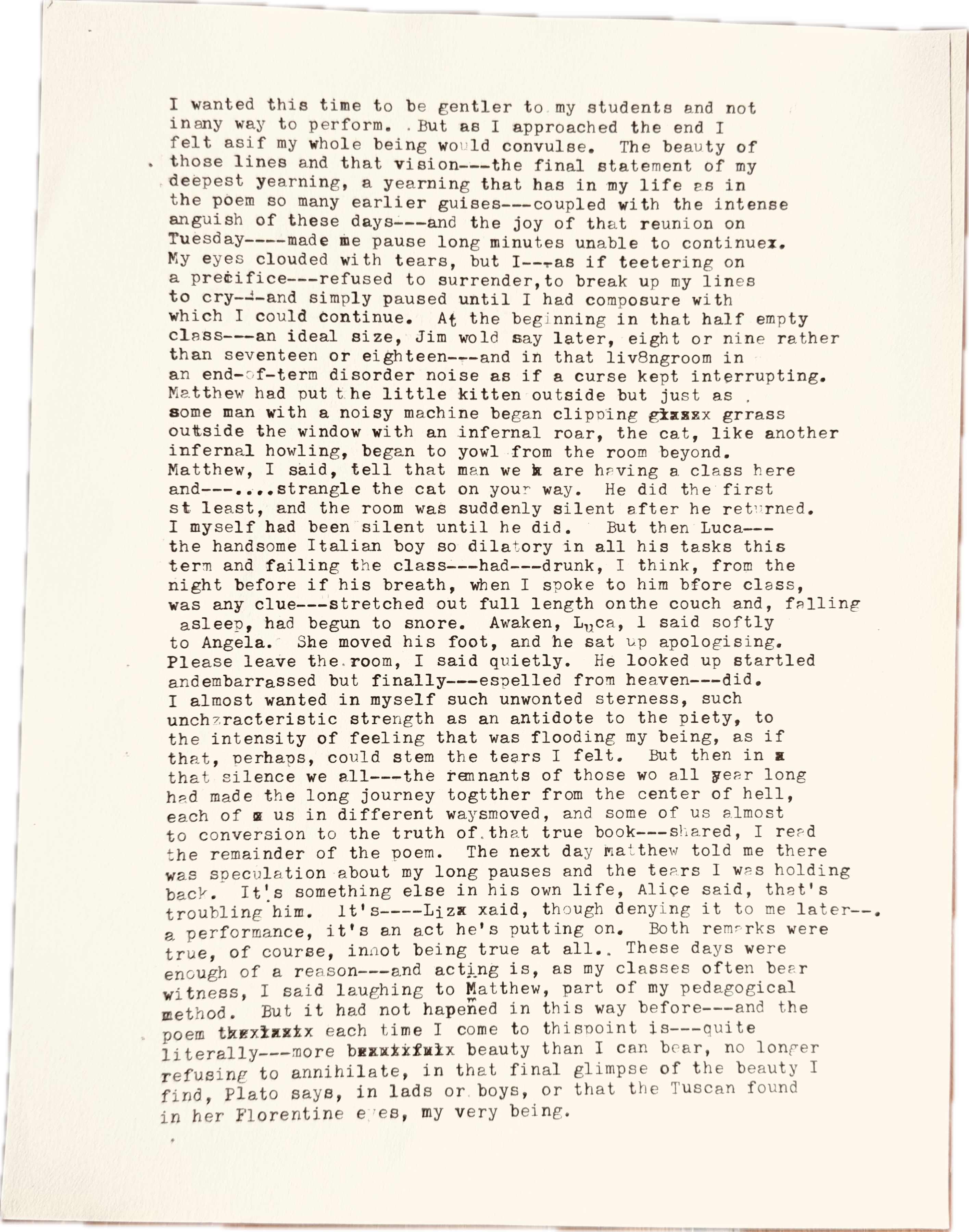
This moment marks the close of a year, a class, and a chapter in Claude’s life—one of devotion to teaching, deep personal longing, and the ever-present passage of time.

The full digital transcript of this entry, along with two others from June 16 and June 21, is available below for paid subscribers. Together, these three entries form a kind of arc—June 16 provides the lead-in, capturing the emotional and intellectual tensions leading up to this moment; June 18, the centerpiece, is where everything converges in the final class, the reading of Dante, the parting of the term; and June 21 offers a kind of resolution, as Claude reflects on the days just past, on what lingers, and on what remains unresolved.
These pages give a fuller picture of Claude’s final days at Bennington that year—his reflections on his students, his private struggles, and his vision of what it meant to teach and to love.
Paid Subscribers Get Access To:
The complete journal entries from June 16, 18, and 21, 1982
High-resolution images of all 15 holograph pages
A deeper dive into Claude’s reflections on Bennington and his personal life
[🔓 Upgrade to paid to unlock full access.]
Claude in His Own Words
Here are three passages from these entries that reveal the depth of Claude’s experience during these days.
On Love & Separation—Claude captures a moment of profound physical and emotional intimacy:
Never have I felt in my life someone’s body so entirely dissolve in mine. It is as if sex were not necessary. We seem to—fit, and he presses and clings and dissolves in a way I have never known. —16 June 1982
On Teaching & Dante—He struggles to finish reading the last lines of the Paradiso, overwhelmed by the moment:
I had nothing really to say except a few brief words of modest explanation here or there, and finally I let only Dante’s voice be heard. The last time I taught those last canti I came to a point where I could read no more—but closed the book, too moved to speak, and dismissed the class. —18 June 1982
On Transition & Uncertainty—In the days after, a strange quiet sets in—an acceptance, and yet, a waiting:
I feel it now. It is not ruthless or unbearable, it is simply a sense of incompleteness, of biding time, of making time pass. I almost like it. —21 June 1982
These glimpses into Claude’s thoughts reveal the interplay of intellect, devotion, and longing.
Coming Up Next
Next week, I will be sharing other entries from Claude’s later years at Bennington—likely from the late 1980s or early 1990s. And for paid subscribers, I will include a rare bonus: a short audio clip from one of Claude’s recorded classes, preserved from his final years of teaching.
Stay Engaged and Share the Journey
I’d love to hear your thoughts! Please leave a comment on this post in the Substack app or below. If you’re enjoying these glimpses into Claude’s world, consider resharing this post with friends who might be intrigued by Claude’s life and work—it’s a great way to help grow this community.
Copyright Notice
All journal entries and photographs are © Marc Harrington. No portion of these materials—whether photographs, full journal entries, excerpts, or extracts—may be used or reproduced in any form without written permission from Marc Harrington. With gratitude to the Getty Research Institute for preserving the original manuscripts.
Claude Fredericks (1923–2013) was a writer, printer, playwright, and longtime professor of literature at Bennington College. For more than 80 years, he kept an extraordinary journal—65,000 pages now preserved at the Getty Research Institute—recording the details of his daily life, his teaching, and his private world.
Keep reading with a 7-day free trial
Subscribe to Extracts: From The Journal of Claude Fredericks to keep reading this post and get 7 days of free access to the full post archives.