

A January Return: Paris with Claude, Winter 1998-99

I haven’t published an Extract since mid-November, and I want to say why before returning to the pages themselves. . .
Christmas 2025 was just over three weeks ago. For much of December, Edward and I were simply busy. He was deep in the holiday rush at Mettowee Mint, where he manages retail operations during their most demanding season. I was immersed in GNAT-TV’s year-end solicitation campaign, which took nearly all my attention through the end of the year. By the time the holiday week arrived and things finally slowed, I was mostly just tired — not in a poetic way, but in a practical, flat, end-of-year kind of way.
Still, I had been thinking about Claude a great deal. Christmas has always done that. So many of our travels together happened during the holidays—often deliberately. It was a way to leave Vermont during the darkest weeks of the year and also, if I’m honest, a way to step outside the obligations and tensions of family gatherings, which could sometimes be difficult for both of us. Paris, Rome, Les Saintes — these places became our alternate calendars, the year turned away from family pressure and toward something quieter and more private.
When I pulled these journal pages from December 1998 and early January 1999, I thought at first that publishing a Christmas entry might simply be fun—a seasonal return, a small gift particularly to paid subscribers who have stayed with me in this work. But reading them again this January, I realized they carried more weight than I had expected.
What struck me immediately is how, on the very first page, beauty and anxiety sit together. The trip is radiant, but the undercurrent is unmistakable:
Last night—unlike the night before—I awoke anxious sometimes—at my my own behavior, at the letters and cards I have not written (I have not written any to anyone these weeks) and even about the preparations for Christmas Marc and I will be making these days now, gifts and a tree for a holiday precious to him, the first he’s ever passed away from his family even if we on our San Silvestros these years have had our own, a sudden anxiety at leaving this strange and beautiful city now all too soon (have already three weeks passed, must we leave in only three weeks more?) and the things we’ve not done or seen, the things that might have delighted my sweet friend more that the things we have indeed done, anxiety at the money I’ve spent, more than I of course realise, debts to be shouldered still again even if the money my mother left me for a moment had lifted it from my shoulders, anxieties more seriously at the consequences of those random and idiot bombings [in Iraq] by American planes of that faraway city with its vast stockpiles or so they say (we were looking at the headlines in the papers, the Herald-Tribune, the Corriere della Sera, Le Monde, at the Deux Magots last night as we had—or before we had—a first and then a second vodka—and the difficulties of getting safely back across the ocean to our green—now our white—island of calm and sweetness, the only Eden, there in the hills of Vermont. . .
That sense of Paris as radiant yet precarious, and Vermont as refuge, quietly organizes everything that follows.
Claude Fredericks (1923–2013) kept one of the longest personal journals ever recorded—over 65,000 pages across eight decades, now preserved at the Getty Research Institute. A poet, playwright, printer, and teacher, he chronicled daily life with rare devotion. Since January, 2025 I’ve been sharing selections from that record here—moments of love, reflection, and artistic insight.
January, Then and Now
Edward was diagnosed with prostate cancer earlier in 2025. After months of anticipation and quiet dread, he had his prostate removed on January 9—just over a week ago. The surgery is behind us now, and he is doing well. We are relieved. We also know recovery will take time, and we are prepared for that.
It’s impossible for me not to register the date.
Claude died on January 11, 2013—also of cancer. He was diagnosed in July 2012. We pursued treatment. Things worsened. Shortly after Christmas, he declined rapidly, and then he was gone. Those weeks were brutal, and January has never been a neutral month for me since.
So here I am, on January 17, returning to another January—one that Claude and I entered together in Paris, at the end of 1998 and the beginning of 1999. The contrast is sharp and also strangely consoling. These pages remind me not just of Claude’s absence, but of how fully present our life together once was: ordinary mornings, shared meals, long walks, museums, illness held at bay, time still expansive.
I owe it to my paid subscribers—many of whom have trusted me with this archive for over a year now—to return to the work with care and steadiness. I also owe it to myself. January is already moving quickly, and I didn’t want to let it pass without stepping back into the record.
What follows are reflections on those Paris days, and then the journal pages themselves.
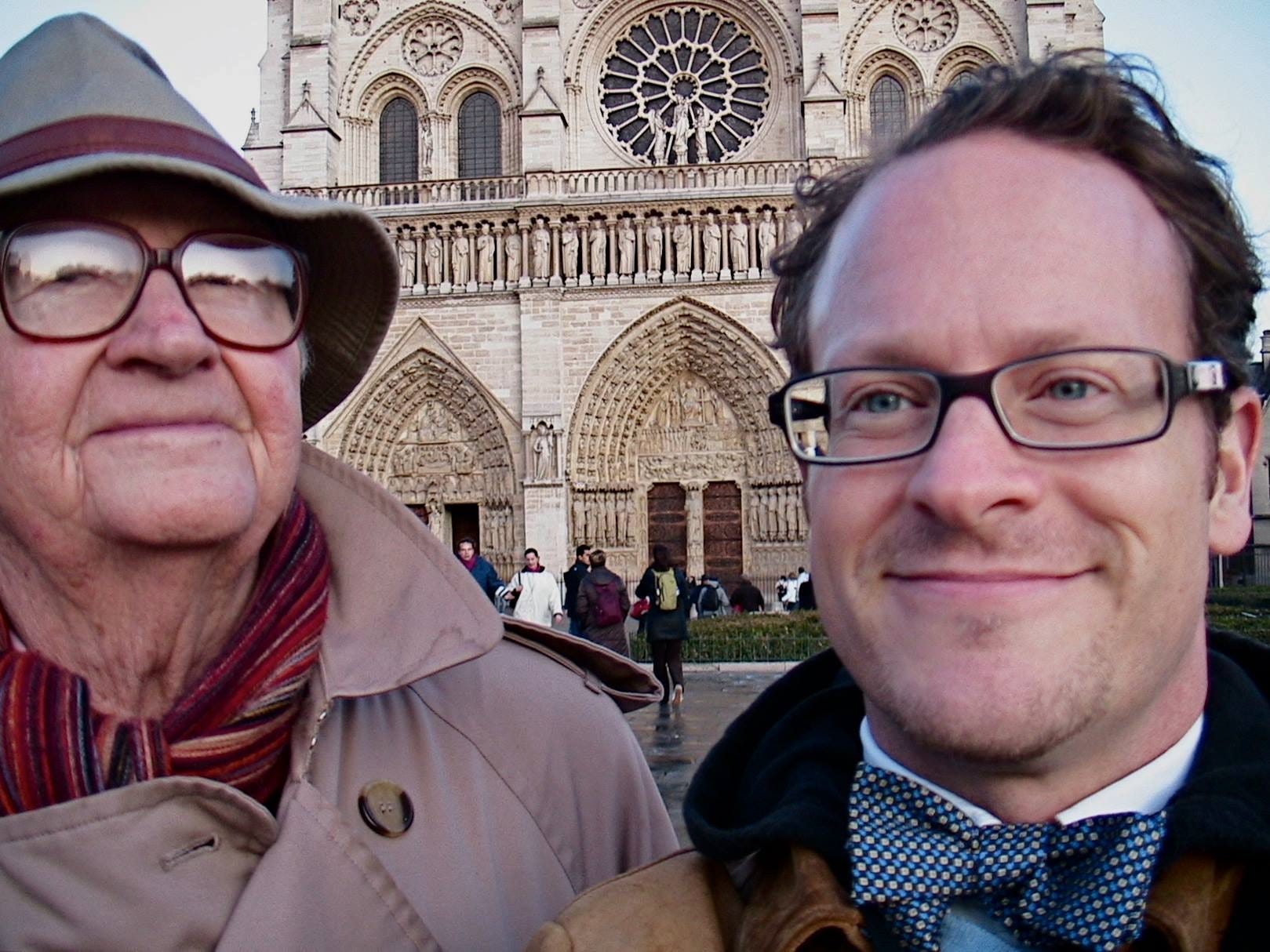
Paris, Winter 1998–99
We arrived in Paris in late November 1998, after two weeks in Aix-en-Provence. We stayed for six weeks, from early December until January 15, 1999. Aix had been sunny but fierce, the mistral relentless. Paris was darker, often gray, and it seemed to get dark by three in the afternoon. Still, it had its own brightness — even when the sky was low, damp, and heavy.
We rented an apartment on the top floor of a five-story historic building on the rue Jacob, a beautiful street lined with antique sellers and interior design shops. The building had an interior courtyard and a small balcony, which meant a lot of light despite the season. The apartment itself was clean, bright, and tasteful.
I remember photographing the massive lacquered doors up and down the street — glossy grays and blues most of all, though there were greens and reds too — heavy doors with ornate knockers, stone moldings, sometimes sculpted figures guarding the entrance. I photographed them the way other people photograph monuments. If this period has a color in my memory, it isn’t a single one at all, but a family of blues and grays — winter light caught on polished paint, a kind of Parisian gloss.
Our Daily Rhythm
We ate very well. Sometimes extravagantly. We went to Le Jules Verne on the Eiffel Tower, where years later, in September 2019, Edward and I would celebrate our honeymoon dinner. We went to Le Grand Véfour, where Claude writes in these pages about sitting in Balzac’s seat. We went to L’Ambroisie tucked under the arches in the Place des Vosges, then the most highly rated Michelin-starred restaurant in Paris. But our real favorite was Taillevent, where we went at least twice on that trip — and where the maître d’hôtel there always asked if we’d like to sit ‘côte-à-côte’ ou ‘face-à-face’? Claude always chose côte-à-côte, and so we sat side by side on a banquette together in that wood-paneled room as if it were the most ordinary thing in the world.
We loved the brasseries too—Lipp and Balzar—and a tiny restaurant near us on the rue Saint-Benoît called Le Petit Saint-Benoît, run by amazingly efficient, slightly tough women. Tight tables, elbow to elbow, the best comfort food on cold winter nights. We also grew fond of the Café des Beaux-Arts near the Beaux-Arts school (now gone). And often, we simply bought food from the traiteurs around rue de Buci, very close to the apartment. We had a good kitchen. For Christmas dinner, we roasted a beautiful whole capon.
We walked constantly—down the rue Jacob to the rue de Buci markets, then along the narrow, touristy but ancient rue Saint-André-des-Arts toward Saint-Michel and the Seine, and back again. That route became pure muscle memory. Christmas Eve Mass at Notre-Dame, then the slow walk home through Saint-Germain-des-Prés in the early hours, remains one of my most vivid memories of that winter.
We were also within a couple blocks of places that anchored our days: the Place de Furstemberg, the Café de Flore, and Les Deux Magots — where we’d stop for tea, a kir, a vodka, and Le Monde or Paris Match from the corner newsstand. Claude mentions the bookstore between the cafés; I know exactly which one he means — La Hune, sophisticated and high-minded on the Boulevard Saint-Germain (now gone), close enough that it became part of our mental map even when we didn’t set out for it.
Inside the Days
These journal entries come from the middle ten days of our six-week stay. What feels secret about them, even now, is how much time we spent inside.
Mornings were quiet. Claude wrote in his journal—I insisted he bring the Olivetti Valentine, which I carried in a small backpack all the way to Europe. More often than not, I ran downstairs to the bakery for croissants, we had them with jam and yogurt, and brewed coffee in the little Napolitano pot we brought everywhere — Wellfleet, Menemsha, Long Island in Maine, Les Saintes, Rome, Paris. It followed us like a small ritual object.
While Claude wrote, I spent thirty to forty-five minutes doing what he called my ‘askesis’ — which was really just calisthenics in the next room. We had a small lunch, then went out in the afternoons until early evening. Claude had chronic knee problems, and the apartment was five flights up, so we usually went out just once a day. That was fine with me.
What mattered most was the texture of the mornings. Here’s how Claude describes that rhythm on December 28:
We were awake by nine-thirty (it is barely light in the bedroom here before nine) and making love so long and so sweetly (what is sweeter, what is happier, how is it possible I waited all these years to find only now perfect joy and fulfillment in making love?) and bathed then and had coffee siting on the couch here, as we do.
Marc these days wants me to write here even more than he seems to want me to write here on other occasions, setting this machine out for me, wanting me to stop ironing shirts or washing dishes, and that in itself is—it’s interesting it is so—impetus.
The trip was not simply what we saw. It was how we lived inside time together.
We also carried a few small objects that became part of our life together long after the trip. I bought Claude a reddish-orange lacquer box at a design shop on the rue Jacob that Christmas; for years afterward we kept our passports in it, along with our Cartes Oranges, our Amis du Louvre membership cards, and French francs (this was before the euro). Nearby, we discovered the new MUJI shop near Saint-Sulpice, where Claude loved buying simple, beautiful stationery — some of which I still have. That lacquer box still smells faintly of paper, ink, and travel.
Small Frictions
It was a dark winter in Paris. Cloudy much of the time. Less wind than Aix, but damp. We both caught colds; Claude’s lingered into January. Still, the apartment stayed bright, and we were buoyed by museums, restaurants, and concerts.
Some things irritated me then that now feel almost tender. Claude was seventy-five; I was twenty-nine. His physical limitations could be frustrating, though they were never really a problem. My French still faltered — despite years of study, despite practicing with Claude, despite wanting it to be better than it was. Parisians often switched to English when they sensed it, as they so often do.
Claude, by contrast, moved through the city as if it were his second home—which, in many ways, it was. He spoke French beautifully (and Italian too), and he loved talking to people: the shopgirls at the cheese shop, the pasta shop, the fish market on rue de Buci; the man at the tabac where we bought stamps; the cashiers at Monoprix and Carrefour. Paris had been in him for decades — childhood visits with his mother in 1934, postwar returns in 1950 with rooms arranged by Alice B. Toklas near Saint-Sulpice, long stays later on, including the early 1990s.
He also carried the city’s older mythology without trying: Alice, Natalie Barney, Raymond Duncan, Julien Green — names that can sound like literary decoration on the page, but in Claude’s life were simply part of his past. In these entries you can feel that layering: the present tense of a market run, the memory of a salon, the fact of a life that has moved through many Parisian decades.
During that trip, Claude also reached out to the daughter of Annie Dalsace, whose husband had commissioned the Maison de Verre, designed by Claude’s close friend Pierre Chareau. Pierre and his wife Dollie had been refugees in New York after the war, where Claude first knew Dollie through Anaïs Nin. Just after the new year, their daughter and son-in-law gave us a private tour of the house — an extraordinary building defined by its translucent glass-block walls and steel frame, light streaming through the panes in unexpected ways, an intimate work of modernism tucked behind a courtyard on rue Saint-Guillaume. When we returned to Paris in spring 2000, we brought her maple syrup from Vermont, as we also did for Jean-Claude Vrinat at Taillevent, whom we had come to know and admire. These small courtesies — syrup carried across an ocean — felt like our quiet way of carrying Vermont into Paris.
There are things I wish we hadn’t done. We went to Versailles on a Saturday shortly after these entries and got sick afterward. It was packed with tour buses. Claude developed a respiratory infection and was ill for much of our last stretch, even once we were back in New York. His doctor said it was nearly pneumonia. We should have listened to our instincts that day.
Paris gave us immersion in a great capital. Vermont gave us quiet, structure, Hank the cat, and our reclusive life in Pawlet — Sam, the retired postman, taking care of house and home while we were away. After two months, we were ready to return.
Projection, Memory, and Return
The air in Paris tasted of cigarette smoke. I had quit in 1995, but the trip stirred something older — an adolescent fantasy of cafés and narrow streets, the dreamy ‘artsy’ version of myself who once imagined Gauloises, Paris tables, cute French boys, and a life made by walking.
1998 had its own texture too. In Aix and then in Paris, it was the first time I noticed how many people had cell phones — young men on mopeds selling mobile plans to pedestrians on the Cours Mirabeau — and I remember being astonished when a waiter ran a credit card at the table on a handheld device and printed the receipt right there. Little flashes of the future inside a city that otherwise felt ancient.
At night, from the bedroom window overlooking the courtyard, we heard neighbors moving about. One woman practiced opera trills. Another expressed her pleasures loudly and without apology. It all felt entirely Parisian.
Near the end of our stay, the January 2 entry gathers all of this—place, time, and love—into a single, resonant moment:
A sometimes troubled night—awakening to a dream I still cannot quite face, awakening at moments to uneasy thoughts still again even with less reason than before that these weeks in this city that makes neither of us entirely happy may be harming the perfect love that exists between my perfect friend and me, a love that has as one of its many blessings the fact that for the first time my love—and the love my friend feels for me—is such that I feel no anxiety of any kind, perfectly secure a first time in my whole life in such love, suffering neither from jealousy or desire, knowing that all I am—and increasingly my body itself and the act of sex that grows always more miraculously joyous in sweetness that is indescribable, but my mind, my heart my character, my whole being—is perfectly and entirely loved, a freedom like none that is conceivable.
Reading these pages now, in early January 2026, I’m struck by how they form a hinge: the end of one year, the beginning of another, Claude beginning to worry about his health and the future, even as we were living fully inside those days. I hear echoes of that life still—in the sound of Edward moving in the next room as I write this, in the way a life keeps narrating itself, even as time changes the cast.
Upgrade to Paid
For paid subscribers below: the complete journal entries from December 19, 1998 through January 2, 1999 — including high-resolution images of all 22 original single-spaced, typewritten pages, along with a full digital transcript.
Looking Ahead
Thank you for traveling with me into this Paris winter. I’m grateful you’re here.
In the next Extract, I’ll step back in time — and back across the Atlantic — to pick up with Claude in Springfield, Missouri in the spring of 1941.
By then, he and his mother had left the penthouse of the Kentwood Arms for a house she had purchased, and Claude had claimed his own space in the attic. Having already completed his coursework, he was excused from twelfth grade and spent what would have been his senior year reading voraciously — the classics, Freud, modern literature — while writing poems, plays, and, of course, continuing his journal with astonishing intensity.
It was also the moment of his first great love — with his mother’s decorator, Henry — an attachment both thrilling and painful, and one that shaped much of what followed.
From there, we’ll move forward into his Harvard years, 1941–1943, where the journal becomes even more intellectually electric, socially vivid, and emotionally complex.
Copyright Notice: All journal entries and photographs are © Marc Harrington. No portion of these materials—whether photographs, full journal entries, excerpts, or extracts—may be used or reproduced in any form without written permission. With gratitude to the Getty Research Institute for preserving the original manuscripts.

Keep reading with a 7-day free trial
Subscribe to Extracts: From The Journal of Claude Fredericks to keep reading this post and get 7 days of free access to the full post archives.